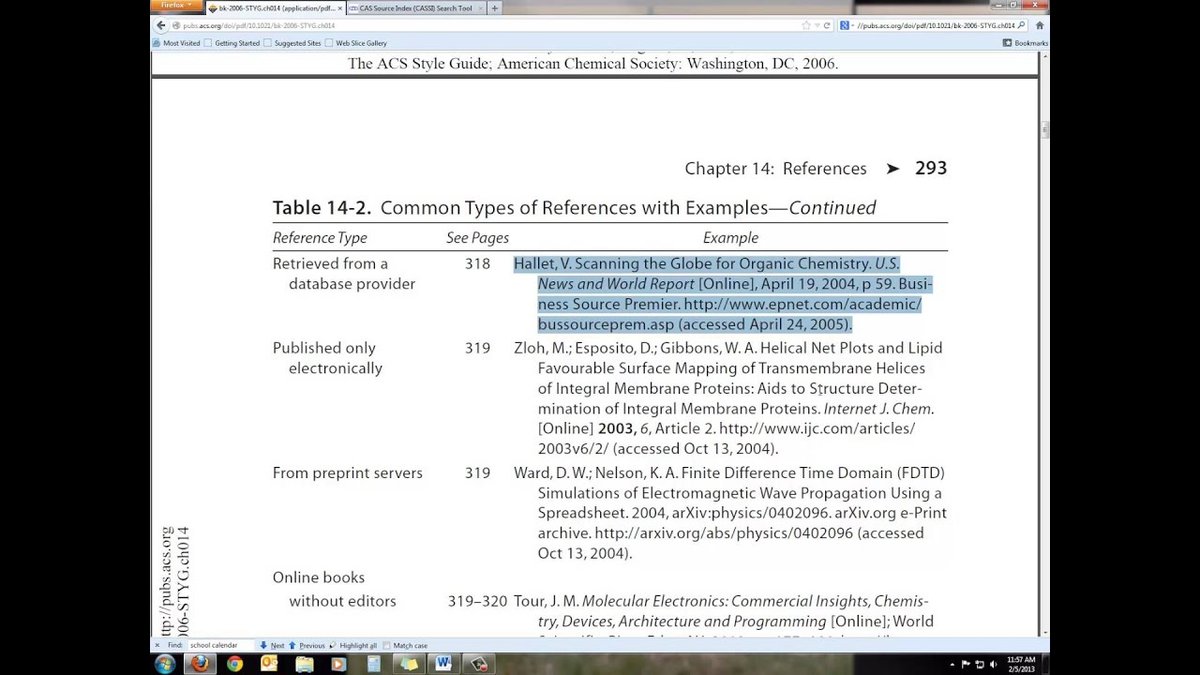
Navigating the intricate world of scientific publishing can feel like learning a new language, especially when it comes to properly crediting your sources. For chemists, biochemists, and related scientific disciplines, understanding In-Text Citations and Bibliography in ACS style isn't just a formality—it's the bedrock of academic integrity and clear communication. Forget about generic citation guides; this is your go-to resource for mastering ACS style, ensuring your research stands on a foundation of unimpeachable credibility and clarity.
At a Glance: ACS Style Essentials
- Purpose: ACS (American Chemical Society) style dictates how to write, format, and cite sources in chemical research papers.
- In-Text Citations: Acknowledge sources immediately after quoted or paraphrased content.
- Three Methods: Choose between superscript numbers, italic numbers in parentheses, or Author-Date in parentheses. Consistency is key!
- Reference List: A comprehensive list of all cited sources, appearing at the end of your paper on a new page.
- Ordering: Numerical methods lead to a numerically ordered reference list; Author-Date method leads to an alphabetically ordered list.
- Common Sources: Specific formats for books, journal articles, websites, and more, each with precise punctuation and element order.
- Tools: Services like ZoteroBib and our own specialized tools can help automate the process, but always double-check.
Why ACS Style Matters: Beyond Just Avoiding Plagiarism
In the fast-paced world of scientific discovery, precision is paramount. Every measurement, every observation, and every conclusion is scrutinized. The same rigor applies to how you present your work and, crucially, how you acknowledge the contributions of others. ACS style isn't just a set of arbitrary rules; it's a standardized language designed by the American Chemical Society to ensure clarity, consistency, and traceability in chemical literature.
By adhering to ACS guidelines for in-text citations and your bibliography, you're not just avoiding plagiarism; you're building a verifiable chain of evidence for your claims. You're allowing your peers to easily locate your sources, verify your information, and build upon your research. This consistency fosters trust and facilitates the advancement of scientific knowledge, making your work a valuable contribution rather than a confusing outlier.
The Dual Pillars: In-Text Citations and the Reference List
Think of ACS citation style as a two-part system, each component playing a vital role in guiding your reader.
- In-Text Citations: These are your immediate signals within the body of your paper, flagging exactly where you've drawn information from an external source. They're quick, unobtrusive markers that keep your narrative flowing while ensuring proper attribution.
- The Reference List (or Bibliography): This is the exhaustive directory at the end of your paper. Each in-text citation points to a corresponding, detailed entry here, providing all the necessary information for your reader to find the original source. Without a complete and accurate reference list, your in-text citations are effectively dead ends.
Mastering both aspects is essential for producing a polished, credible, and ACS-compliant scientific paper.
Mastering In-Text Citations in ACS Style
ACS offers three distinct methods for citing sources within your text. The crucial decision is to choose one method and stick with it throughout your entire manuscript. Your instructor or target journal may specify a preferred method, so always check their guidelines first.
Method 1: The Subtle Superscript Number
This is perhaps the most common and least intrusive method, often favored for its clean appearance. You place a superscript number directly after the piece of information, quote, or paraphrase you've taken from a source.
How it Works:
- Assign each source a unique number in the order that you first reference it in your paper.
- If you cite the same source again later, use its original assigned number. Do not assign it a new number.
- The number typically appears after punctuation, unless it refers to a specific word or phrase, in which case it might appear directly after that element.
Example:
The synthesis pathway was optimized for yield and purity.² This approach significantly reduced reaction time.³ Further studies confirmed the compound's stability.²
Key Takeaways: - Sequential Numbering: Sources are numbered as they appear.
- Re-use Numbers: Once a source has a number, always use that same number for subsequent citations of that source.
- Placement: Usually at the end of a sentence or clause, after the punctuation.
Method 2: Italic Numbers for Clarity
Similar to the superscript method, this approach also uses numerical ordering, but the numbers are enclosed in parentheses and italicized. It offers a slightly more visible in-text marker than a superscript.
How it Works:
- Just like with superscripts, each source gets a unique, italicized number in parentheses, assigned in the order it first appears.
- Re-use the original number for subsequent citations of the same source.
- The number generally appears at the end of the sentence or clause.
Example:
The enzyme exhibited potent catalytic activity (1). Subsequent trials revealed a similar effect across different substrates (2, 3). These findings align with earlier reports (1).
Key Takeaways: - Sequential and Re-usable: Same numbering logic as superscripts.
- Visibility: Slightly more prominent than superscripts.
- Parentheses and Italics: Don't forget both.
Method 3: Author-Date – When Context is Key
This method provides more immediate context within your text by including the author's last name and the publication year. It's often preferred when the specific researcher or the timeliness of the research is relevant to your discussion.
How it Works:
- Place the author's last name and the year of publication in parentheses after the cited information.
- If multiple authors, include the first author's last name followed by "et al." (meaning "and others") for three or more authors.
- If the author's name is part of your sentence, only the year goes in parentheses.
Examples:
The compound demonstrated significant neuroprotective effects (Smith, 2018).
According to Smith (2018), the compound showed significant neuroprotective effects.
Similar results were observed in related studies (Johnson et al., 2019).
Key Takeaways: - Author's Last Name and Year: Provides direct attribution.
- "et al.": Use for three or more authors in the in-text citation.
- Integration: Can be smoothly woven into your sentence structure.
Choosing Your In-Text Citation Method
The choice largely depends on journal requirements, your instructor's preference, or your personal preference for how "interrupted" you want your text to feel.
- Superscript/Italic Numbers: Ideal for dense scientific writing where minimizing textual clutter is a priority. The focus remains squarely on the scientific findings.
- Author-Date: Excellent for humanities-style scientific arguments where discussing specific researchers' contributions or the historical progression of ideas is important. It foregrounds the human element of research.
Crucial Advice: Whichever method you select, apply it consistently throughout your entire paper. Mixing and matching methods will immediately flag your paper as unprofessional and inconsistent.
Building Your ACS Reference List: The Blueprint for Credibility
Your reference list, often titled "References" or "Bibliography," is where you provide the full, specific publication details for every source you've cited in your paper. It starts on a new page at the very end of your document. The format and order of entries in this list depend directly on the in-text citation method you chose.
Ordering Your Reference List
- If you used Superscript or Italic Numbers for in-text citations: Your reference list entries must be arranged in numerical order, matching the numbers assigned to them in your text.
- If you used the Author-Date method for in-text citations: Your reference list entries must be arranged alphabetically by the last name of the first author.
General Principles for ACS Reference Entries
Regardless of the source type, most ACS reference entries follow a logical flow, providing the essential "who, what, where, and when" of the publication:
- Authors: List all authors, separated by semicolons. Use last name first, then initials (e.g., Smith, J. D.).
- Title: The title of the specific work (article, chapter) or the larger work (book, journal).
- Source Information: This is highly dependent on the source type (e.g., journal name, volume, pages; publisher, location, year for books).
- Punctuation: ACS style uses specific punctuation (periods, commas, semicolons, italics) to delineate different elements. Pay close attention.
- Online Access Information: For online sources, include a URL and the date accessed.
Now, let's dive into the basic formats for common source types, complete with breakdowns and examples.
Common Source Formats Explained
Books (Print)
Format:
Author 1; Author 2; etc. Title of Book, Edition Number; Publisher: Location, Year; Volume number, pp Pages Used.
Breakdown:
- Author(s): Last name, First initial. Middle initial. (e.g., Brown, C. A.; Jones, E. R.). Separate with semicolons.
- Book Title: Italicized. Capitalize main words.
- Edition Number (Optional): If applicable (e.g., 2nd ed. or Rev. ed.).
- Publisher: Name of the publishing company.
- Location: City of publication.
- Year: Year of publication.
- Volume Number (Optional): If part of a multi-volume set (e.g., Vol. 2).
- Pages Used (Optional): Specific page range cited (e.g., pp 25-30).
Example:
Chang, R. Chemistry, 10th ed.; McGraw-Hill: New York, 2010; pp 115-120.
E-Books
Format:
Author 1; Author 2; Author 3; etc. Book Title [Online]; Series Information; Publisher: Place of Publication, Year; Volume Number, Pages Used. URL (accessed Month Day, Year).
Breakdown:
- Author(s): Same as print books.
- Book Title: Italicized.
- [Online]: Crucial indicator for electronic format.
- Series Information (Optional): If part of a series (e.g., ACS Symposium Series; No. 700).
- Publisher: Name of the publishing company.
- Place of Publication: City of publication.
- Year: Year of publication.
- Volume Number (Optional): If applicable.
- Pages Used (Optional): Specific page range cited.
- URL: Full URL where the e-book can be found.
- Accessed Date: (accessed Month Day, Year).
Example:
Harris, D. L.; Adams, G. B. Organic Reaction Mechanisms [Online]; Wiley-Interscience: New York, 2015; pp 55-62. https://www.example.com/organic-rxns (accessed Feb 28, 2023).
Scholarly Journal Article (Print)
Format:
Author 1; Author 2; Author 3; etc. Title of Article. Journal Abbreviation Year, Volume, Pages.
Breakdown:
- Author(s): Same format as books.
- Article Title: Capitalize only the first word and proper nouns. No italics or quotes.
- Journal Abbreviation: Italicized. Use official ACS abbreviations (e.g., J. Am. Chem. Soc.). If unsure, use the full journal title.
- Year: Year of publication.
- Volume: Volume number (often in bold, but check specific journal guidelines).
- Pages: Start and end page number, separated by a hyphen.
Example:
Nguyen, T. T.; Johnson, S. R. Synthesis of Novel Heterocyclic Compounds. J. Org. Chem. 2019, 84, 1234-1240.
Scholarly Journal Article (Library Database)
Format:
Author 1; Author 2; Author 3; etc. Title of Article. Journal Abbreviation [Online], Date, Pages. Database Name. Complete URL of database (accessed Date).
Breakdown:
- Author(s), Article Title: Same as print journal article.
- Journal Abbreviation: Italicized.
- [Online]: Indicates electronic format.
- Date: Year, Volume, Issue (e.g., 2020, 12, No. 5).
- Pages: Start and end page number.
- Database Name: Name of the specific library database (e.g., SciFinder, Web of Science).
- Complete URL: The permalink or URL to the article within the database.
- Accessed Date: (accessed Month Day, Year).
Example:
Chen, L.; Wang, P. Advances in Catalytic Asymmetric Reactions. Angew. Chem., Int. Ed. [Online], 2021, 60, 4567-4572. Scopus. https://www.scopus.com/inward/record.uri?eid=2-s2.0-850987654321 (accessed Mar 1, 2023).
Scholarly Journal Article (Open Web)
Format:
Journal Abbreviation [Online] Year, Issue, Pages. Complete URL (accessed Date).
(Note: This format is less common as most open-web articles will have explicit author/title details like the print/database version, but if only this minimal info is available, follow it.)
More typical for open web journal articles, assuming author/title info is present:
Author 1; Author 2; etc. Title of Article. Journal Abbreviation [Online] Year, Volume, Pages. Complete URL (accessed Month Day, Year).
Example (using the more complete format):
Miller, E. K.; Thompson, F. R. Green Chemistry in Polymer Synthesis. Environ. Sci. Technol. [Online] 2022, 56, 7890-7897. https://pubs.acs.org/doi/10.1021/acs.est.2c00000 (accessed Mar 5, 2023).
Magazine or Newspaper Articles
Format:
Author 1; Author 2; Author 3; etc. Title of Article. Title of Periodical, Complete Date, Pages. For newspapers, include "p." or "pp." before page numbers; list discontinuous pages separated by a comma. If online, include "Retrieved from" and the URL.
Breakdown:
- Author(s): As before. If none, start with the article title.
- Article Title: Capitalize only the first word and proper nouns.
- Periodical Title: Italicized. Use full title for magazines/newspapers.
- Complete Date: Full date of publication (e.g., July 15, 2022).
- Pages: For newspapers, use "p." for a single page, "pp." for a range (e.g., p B1, pp A1, A4).
- Online Version: If accessed online, add "Retrieved from" and the URL.
Examples: - Print Magazine: Ramirez, L. The Future of Battery Technology. Science Daily, Feb 1, 2023, pp 12-15.
- Print Newspaper: Davis, J. New Breakthrough in Cancer Research. The New York Times, Mar 8, 2023, p A7.
- Online Magazine: Carter, S. The Race for Clean Energy. Scientific American. https://www.scientificamerican.com/article/clean-energy-race/ (accessed Mar 10, 2023).
Website
Format:
Author, X (if any). Title of Site. URL (accessed Month Day, Year), other identifying information (if any).
Breakdown:
- Author(s): If a specific author is listed for the content, provide it. Otherwise, omit.
- Title of Site: Italicized. This could be the title of a specific page or the overall website.
- URL: The complete web address.
- Accessed Date: (accessed Month Day, Year).
- Other Information (Optional): Publisher, sponsor, date of last update, etc., if available and useful for identification.
Example:
National Institutes of Health. Alzheimer's Disease Fact Sheet. https://www.nia.nih.gov/health/alzheimers/alzheimers-disease-fact-sheet (accessed Feb 20, 2023).
Example with author:
Chen, S. Understanding Spectroscopy. https://www.chemwebguide.com/spectroscopy-guide (accessed Jan 15, 2023).
Punctuation and Formatting Nuances: The Devil in the Details
ACS style is highly particular about punctuation. A misplaced comma or a forgotten semicolon can render a citation incorrect.
- Semicolons (;): Used to separate authors, and often used between major fields in an entry (e.g., between publisher and location).
- Periods (.): Used to end each complete entry and sometimes after specific elements.
- Commas (,): Used to separate elements within a field (e.g., city and state).
- Italics: Used for book titles, journal abbreviations, and website/periodical names.
- Bold: Often used for journal volume numbers, but check specific journal guidelines.
- Abbreviations: ACS uses specific abbreviations for common words in titles and for journal names. The Chemical Abstracts Service Source Index (CASSI) is the definitive resource for journal title abbreviations. If you can't find an abbreviation, it's safer to use the full journal title.
Leveraging Tools for Accuracy
Let's be honest: meticulously formatting every citation by hand can be tedious and prone to error. Fortunately, a host of tools can help streamline the process, though none should be used without a careful human review.
- ZoteroBib: A fantastic free online tool that can help you generate bibliographies in various styles, including ACS. You simply paste URLs or ISBNs, and it attempts to create the citation for you.
- Reference Management Software: Programs like Zotero, Mendeley, and EndNote allow you to collect, organize, and cite sources seamlessly. They integrate with word processors to insert citations and generate bibliographies on the fly, and they have built-in ACS styles.
- Online Citation Generators: Many websites offer citation generation. When using these, always proceed with caution. They are algorithms and may not always perfectly capture all the nuances of ACS style, especially for less common source types or specific formatting rules. This is where Our ACS reference generator can be a lifesaver, offering a tailored approach to ensure accuracy for your chemical citations. Always cross-reference against the official ACS Style Guide or the examples provided here.
Common Pitfalls and How to Avoid Them
Even seasoned researchers can stumble. Here are some frequent mistakes and how to sidestep them:
- Inconsistency: The cardinal sin of citation. Mixing superscript numbers with author-date, or using different punctuation styles, immediately undermines your professionalism.
- Solution: Choose one method for in-text citations and one corresponding method for your reference list order (numerical or alphabetical) at the outset and stick to it religiously.
- Missing Information: Forgetting a publisher, an access date, or a page range.
- Solution: Collect all necessary information for each source as you find it. Create a working document or use reference management software to keep track of every detail.
- Incorrect Punctuation/Formatting: The difference between a comma and a semicolon, or regular text versus italics, can be subtle but critical.
- Solution: Develop a keen eye for detail. Compare your citations against established examples (like those above or from the official guide).
- Over-Reliance on Automatic Tools: While helpful, citation generators are not infallible. They sometimes misinterpret fields or omit necessary details.
- Solution: Use tools as a starting point, not a final solution. Always review every generated citation against the official ACS style guidelines to ensure accuracy. Think of it as spell-check for citations—it catches most errors, but not all of them.
- Not Citing Common Knowledge: While true common knowledge (e.g., water is H₂O) doesn't need citation, information that is new to you or specific to a particular study almost certainly does, even if it feels broadly known.
- Solution: When in doubt, cite. It's better to over-cite than to risk plagiarism or misattribution.
- Incorrect Journal Abbreviations: Using a non-standard or incorrect abbreviation for a journal.
- Solution: Consult CASSI for definitive journal abbreviations. If you don't have access, use the full journal title; it's always acceptable.
Your Next Steps to ACS Style Mastery
Navigating ACS style might seem daunting at first, but with practice and attention to detail, it will become second nature. Remember these key takeaways:
- Understand the "Why": ACS style isn't just about rules; it's about clear, credible, and traceable scientific communication.
- Be Consistent: This is the golden rule. Pick an in-text citation method and stick to it, ensuring your reference list follows the corresponding order.
- Pay Attention to Detail: Every comma, period, and italicized word matters. Use the provided formats as templates.
- Utilize Tools, But Verify: Leverage citation generators and reference managers, but always critically review their output.
- Consult the Source: When in doubt, refer to the official ACS Style Guide (the 2006 edition, Call Number: Ref QD 8.5 .A25 2006, is a valuable library resource). While this article covers the essentials, the full guide offers comprehensive details for every conceivable source type.
By embracing these principles, you'll not only produce impeccably cited scientific papers but also contribute to the integrity and clarity of chemical communication, elevating your research and your reputation in the scientific community.